




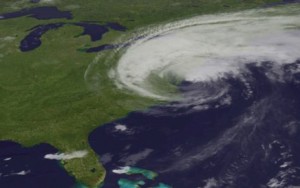
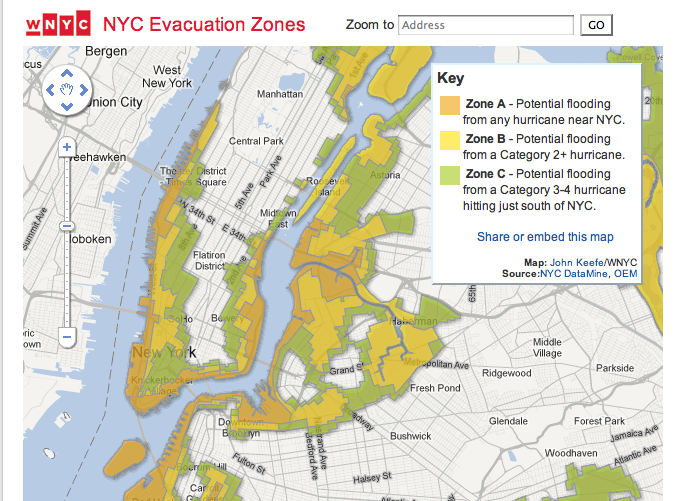
 So recently, Hurricane Irene came blowing through NYC. In the days leading up to the event, city officials did a (perhaps too) great job of letting citizens know how to prepare for a disaster, and – even more importantly – how to gauge the risk. This risk display system could use a little editing, leveraging some of the lessons of gamification. NYC accomplished this by publishing “zones” for flooding risk, based on a set of factors that were kept somewhat obfuscated (but assumed to be elevation and drainage related). The zone concept itself was accompanied by an online map widget that let you see – in simple color – what zone you were in.
This widget was very nicely designed and came in two form factors – the first, a scan/pan, zoomable map of NYC with the zones laid out (brought to you by WNYC):
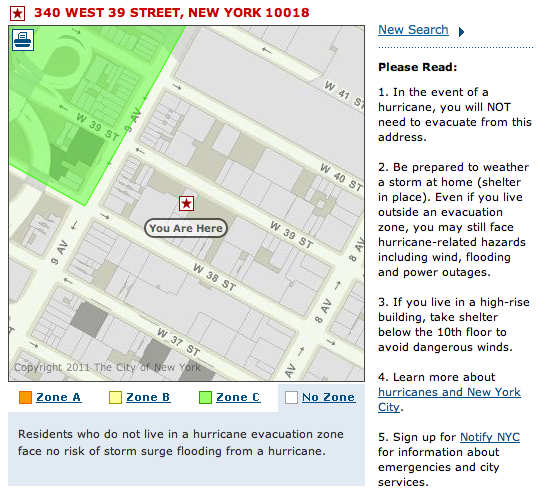
The second, by the city itself, let you enter an address to see what the risk/evacuation conditions were for a given address. The results of that search looked like this:
There are two basic mistakes with this design from a gamification/tiers and levels standpoint that stick out like a sore thumb (or broken windowpane).
The first one is the ranking convention: Zone A is the worst zone to be in. The best zone to be in is the “no zone” zone. In most of our ranking systems, we associate A with the best score one can receive, and C with the worst. We also don’t generally create a ranking system that includes a “non rank” option. We are lucky to live in a non-zone zone, and all throughout the hurricane I struggled to describe our zone in discussion.
The second mistaken convention is the color scheme. They’ve chosen Orange, Yellow, Green and Grey as the ranking colors. In general, Green is the best color to have in most systems (but in this one, it’s grey) and Orange and Yellow are very similar colors. Unless the city’s intention is to someday have a red (“Get out, get out now!”) tier, there doesn’t seem to be much reason to reinvent the tiers here. Perhaps the right ranking would have looked something like this:
- C – No Risk of Flooding
- D – Some Risk of Flooding
- E – Moderate Risk of Flooding
- F – Serious Risk of Flooding
Now doesn’t that make more sense? Also, this time around, the city enforced evacuations on its residents, but a grading system with more intermediate grades (and corresponding warning messages using the color) would make it easier for people to decide if they should evacuate of their own volition. It also leaves room (A, B, and the rest of the alphabet) in case an unforeseen scenario arises that requires more gradation in where the dangers lies. This will be important next time, as folks are unlikely to believe the city’s dire predictions with quite the same gusto.
Separately, I also think it would have been fun for NYC to run a prediction game with regard to the hurricane – it’s stats, closest point to NYC, rainfall, etc. That would have been a fun way to engage the millions of people who stayed in on Saturday night – and to show the lighter side of what could have been a very serious/scary event.
 Gamification Co will be hosting it’s second Gamification Summit in New York on September 15-16. Join keynotes from Gilt Groupe CEO Alexandra Wilkis Wilson and 42 Entertainment’s founder, Susan Bonds, to learn how the new science of engagement is rewriting the rules of product design. We are also offering the first ever Certificate in Gamification. For Gamification Blog readers, use discount code GCOBLOG for 25% off at http://gsummit.com/register. We look forward to seeing you there!